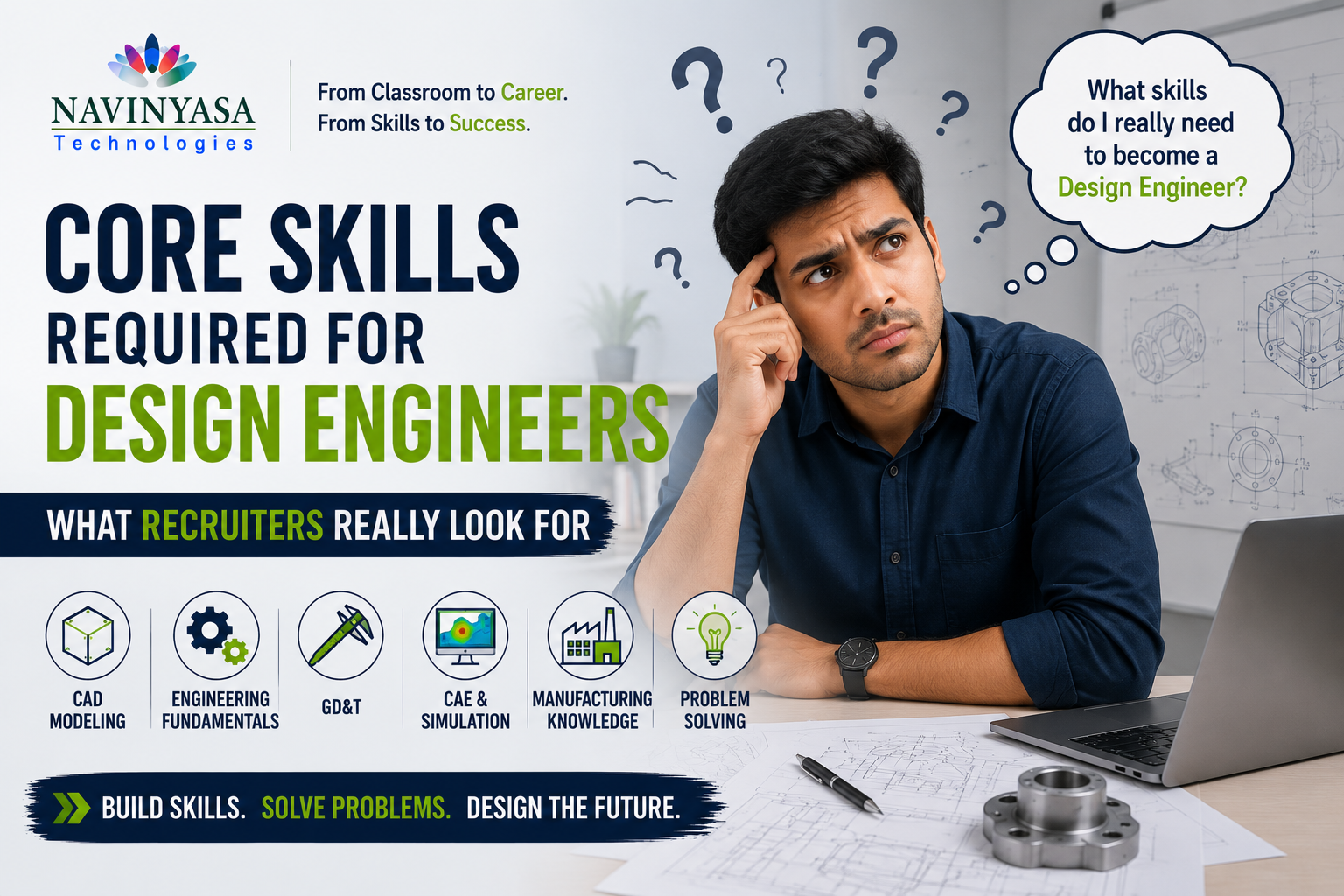
Core Skills Required for Design Engineers: What Recruiters Really Look For
28 Jul 2026
navinyasanew
5 min read
“I know CATIA and SolidWorks, but I’m still not getting interview calls.”
This was the first sentence Rahul, a recent Mechanical Engineering graduate, said during his career counselling session.
Like thousands of fresh graduates every year, Rahul believed learning CAD software alone would be enough to land his dream job.
He had spent months creating 3D models, earning software certificates, and applying for Design Engineer positions. Yet interview opportunities were few, and the ones he attended rarely progressed beyond the first round.
Finally, one recruiter gave him honest feedback:
“You’re good at CAD, but we’re looking for a Design Engineer—not just someone who knows CAD software.”
That single sentence changed Rahul’s perspective and highlights one of the biggest misconceptions among mechanical engineering graduates.
CAD software is only one tool. Design Engineering is much more than creating 3D models.
Who Is a Design Engineer?
A Design Engineer transforms ideas into products that are functional, safe, manufacturable, reliable, and cost-effective.
Whether it’s an automotive component, aerospace assembly, consumer product, industrial machine, or medical device, Design Engineers ensure that products are ready for real-world manufacturing.
They work across the complete product development lifecycle:
Product Concept
Engineering Design
CAD Modelling
Engineering Analysis
Manufacturing Planning
Testing & Validation
Product Improvement
Their responsibility is not simply drawing components—it is solving engineering problems.
Why Design Engineers Are in High DemandIndia’s manufacturing sector is expanding rapidly, supported by growth in:
Electric Vehicles (EV)
Aerospace
Industrial Automation
Defence Manufacturing
Medical Devices
Heavy Engineering
Consumer Products
Industry 4.0
Companies are looking for engineers who can contribute from day one.
Recruiters no longer hire candidates based solely on academic scores or software certificates. They look for practical skills that help solve engineering challenges and improve product quality.
10 Core Skills Every Design Engineer Must Have
1. Strong Engineering Fundamentals
Before opening any CAD software, Design Engineers should understand:
Mechanics
Strength of Materials
Engineering Mechanics
Machine Design
Manufacturing Processes
Material Science
Software cannot replace engineering knowledge.
2. CAD Modelling Skills
CAD remains an essential skill.
Popular software includes:
CATIA
Siemens NX
SolidWorks
Creo
AutoCAD
However, recruiters expect more than creating attractive 3D models.
They want engineers who understand why a component is designed in a particular way.
3. Manufacturing Knowledge
A great design that cannot be manufactured is not a successful design.
Design Engineers should understand:
Casting
Injection Moulding
Sheet Metal
CNC Machining
Welding
Additive Manufacturing
Tool Design
Understanding manufacturing constraints leads to practical and cost-effective designs.
4. GD&T (Geometric Dimensioning & Tolerancing)
Many fresh graduates overlook GD&T.
Yet it is one of the most valued skills in industries such as:
Automotive
Aerospace
Heavy Engineering
GD&T ensures parts are manufactured accurately and assembled correctly.
5. Problem-Solving Ability
Every engineering design solves a problem.
Design Engineers regularly answer questions such as:
How can weight be reduced?
How can manufacturing cost decrease?
How can product reliability improve?
How can assembly become easier?
Employers value engineers who think analytically rather than simply modelling components.
Even basic CAE knowledge helps engineers make better design decisions.
7. Product Development Process
Professional Design Engineers understand the complete lifecycle.
Typical stages include:
Customer Requirement
Concept Design
CAD Modelling
Engineering Analysis
Prototype Development
Validation
Production Release
Knowing where your work fits into this process makes you more effective.
8. Communication Skills
Design Engineers collaborate with:
Manufacturing teams
Quality engineers
Suppliers
Customers
Project managers
The ability to explain design decisions clearly is just as important as technical knowledge.
9. Live Project Experience
Recruiters consistently prioritise candidates who have worked on real engineering projects.
Projects demonstrate:
Practical thinking
Teamwork
Engineering judgement
Problem-solving
Documentation skills
A strong portfolio often outweighs multiple software certificates.
10. Continuous Learning
Engineering evolves rapidly.
Modern Design Engineers stay updated with:
Electric Vehicles
Digital Twins
AI in Manufacturing
Industry 4.0
Smart Factories
Sustainable Product Design
Learning does not stop after graduation.
CAD Engineer vs Design Engineer
This is one of the most common interview questions.
CAD Engineer
Design Engineer
Creates models and drawings
Develops engineering solutions
Uses CAD software
Applies engineering principles
Produces technical documentation
Makes engineering decisions
Focuses on modelling
Focuses on functionality, safety, quality and manufacturability
A Design Engineer typically uses CAD software, but their role extends much further into engineering analysis, validation, and product development.
What Recruiters Really Want
Recruiters are increasingly looking for engineers who can contribute beyond software proficiency. They value candidates who demonstrate:
Practical CAD skills
Strong engineering fundamentals
Manufacturing knowledge
GD&T understanding
Problem-solving ability
Live project experience
Effective communication
Industry readiness
These qualities indicate an engineer who can transition quickly into a professional design role.
How to Become an Industry-Ready Design Engineer
If you’re a Mechanical Engineering student or recent graduate, focus on building a balanced skill set:
Master one industry-standard CAD software.
Strengthen your engineering fundamentals.
Learn manufacturing processes.
Understand GD&T.
Work on real engineering projects.
Develop a professional portfolio.
Gain exposure to CAE and product development.
These steps will significantly improve your employability.
Your Engineering Career Starts with Practical Skills
Rahul’s journey changed when he shifted his focus from collecting software certificates to building engineering capability. He worked on live projects, learned manufacturing concepts, strengthened his design fundamentals, and developed a portfolio that reflected real-world problem solving.
Within a few months, his interview performance improved because he could explain not just how he created a model, but why he designed it that way.
That distinction often separates candidates who are shortlisted from those who are hired.
If your goal is to build a successful career in design engineering, invest in skills that employers value—not just software proficiency.
Looking to Become an Industry-Ready Design Engineer?
At Navinyasa Technologies, our Mechanical Design Training programmes combine CAD, engineering fundamentals, manufacturing knowledge, and live industry projects to help graduates become job-ready Design Engineers.
Whether you’re interested in Automotive, Plastic Product Design, Sheet Metal, Casting, or Manufacturing Engineering, practical learning is the foundation of long-term career success.
Book a Free Demo. See What Design-Ready Training Looks Like.
Build practical mechanical design skills through domain-focused training in Plastic, Casting and Sheet Metal/BIW with live project exposure, manufacturing knowledge and mentor guidance.
Upcoming batches have limited seats. Book a free demo to understand the program structure, domain options and learning approach.
See How Domain Training Can Strengthen Your Design Career.
CAD software knowledge is only the starting point. Explore how practical training in Plastic, Casting and Sheet Metal/BIW, manufacturing processes and live projects can help you move toward design-ready skills.
Upcoming batch • Limited training seats. Book a free demo to understand the training approach before you decide.