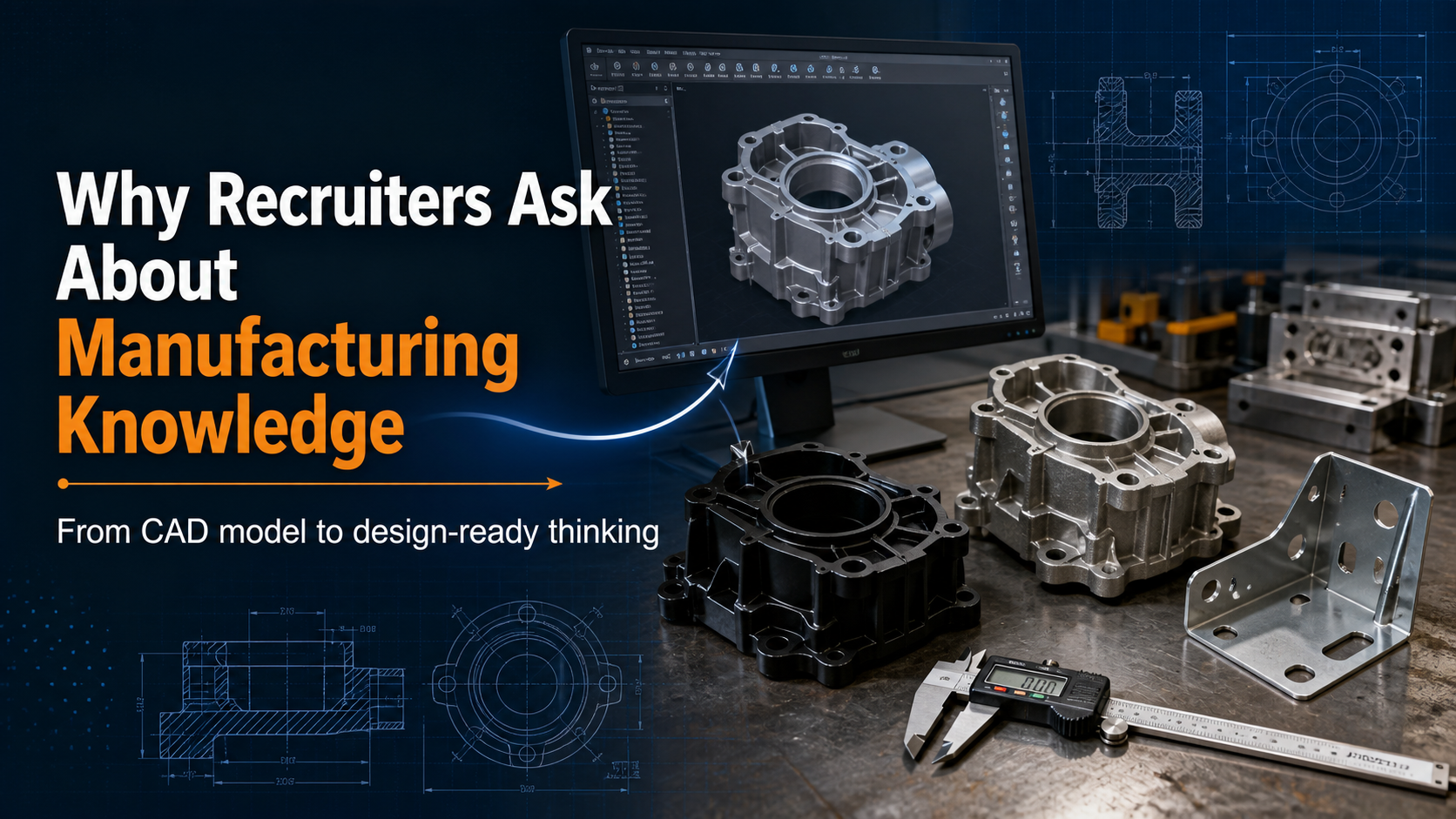
Many Mechanical Engineering students prepare for design interviews by focusing mainly on CAD tools. They spend time learning CATIA, NX, Creo or SolidWorks. They practice 3D modelling, assemblies, drafting and surface commands. This is useful, and it is a good beginning for anyone who wants to enter a design role.
But during interviews, many freshers face a question they did not expect:
“Do you understand how this part will be manufactured?”
At first, this may feel confusing. A student may think, “I applied for a design role. Why is the recruiter asking me about manufacturing?” The reason is simple. In the real industry, design and manufacturing are not separate worlds. A part is not designed only to look good in CAD. It is designed so it can perform its function, fit into an assembly, be manufactured properly, pass testing and be produced at the right cost.
That is why recruiters ask about manufacturing knowledge. They are not trying to make the interview difficult. They are trying to understand whether you can think like a Design Engineer.
CAD Is Important, But CAD Is Not The Complete Design Skill
CAD helps you create the model. It helps you define geometry, dimensions, assemblies and drawings. Without CAD, modern mechanical design work is almost impossible.
But CAD is still a tool. It does not automatically tell you whether your part can be manufactured easily. It does not tell you whether the wall thickness is practical, whether the draft angle is enough, whether the bend radius is suitable, or whether a casting will have shrinkage issues.
A CAD model may look perfect on screen, but it can still fail in production.
This is where manufacturing knowledge becomes important. Recruiters want to know whether you can connect your CAD model with real product conditions. Can you understand material? Can you think about process? Can you consider tooling? Can you reduce manufacturing difficulty? Can you design a part that is not only good-looking, but also practical?
This is the difference between a CAD user and a design-ready engineer.
What Recruiters Actually Look For
Recruiters do not expect freshers to know everything. They know that students are still learning. But they do expect basic design thinking.
When a recruiter asks about manufacturing knowledge, they may be checking whether you understand:
- How the part will be produced
- Which material may be suitable
- Whether the design is easy or difficult to manufacture
- What defects can occur during production
- How the part will be assembled
- Whether the drawing communicates the right information
- How tolerances affect manufacturing and inspection
- Whether the design can meet cost and quality expectations
A design engineer works with many teams: manufacturing, quality, tooling, procurement, validation and assembly. If the designer does not understand manufacturing, the design may create problems for everyone later.
This is why companies value engineers who can think beyond software commands.
Example 1: Plastic Component Design
Imagine you are designing a plastic dashboard trim, door panel, console part or mirror housing. In CAD, you can create the outer shape and mounting features. But a real plastic design engineer has to think deeper.
Is the wall thickness uniform? Is the draft angle enough for ejection? Are the ribs designed correctly? Are the bosses strong enough? Are snap fits placed properly? Where will the parting line come? Can the mould open and close without problems? Will the part warp after moulding?
These questions are not just manufacturing questions. They are design questions.
If a student understands these basics, the recruiter gets a clear signal: this candidate is not only modelling the part, but also thinking about how the part will be made.
For students interested in Plastic Design, this is a very important skill area because automotive interiors, consumer products, appliances and many industrial components use plastic parts extensively.
Example 2: Casting Component Design
Now consider a cast component, such as a bracket, housing, cover or machine part. A fresher may create the geometry in CAD, but recruiters may ask about casting feasibility.
Does the part have proper draft? Is the wall thickness suitable? Can molten metal flow properly? Where will shrinkage happen? Is there enough machining allowance? Is the parting line practical? Can sharp corners create defects? Can ribs be added to improve strength without adding unnecessary weight?
A casting design engineer must understand that the manufacturing process affects the design from the beginning. If this knowledge is missing, the part may require multiple corrections after review.
Recruiters ask these questions because they want engineers who can reduce design rework and support practical product development.
Example 3: Sheet Metal Design
Sheet metal is another important domain for mechanical and automobile engineers. It is widely used in automotive BIW, brackets, panels, enclosures and structural components.
In sheet metal design, a recruiter may ask about bend radius, bend allowance, flange length, holes near bends, forming limitations, weld nuts, hemming, joggles, embosses or assembly constraints.
If a student designs a sheet metal bracket without understanding bending and forming, the part may look correct in CAD but fail during manufacturing. It may crack, deform, become difficult to assemble, or require unnecessary tooling changes.
That is why recruiters look for basic sheet metal awareness when hiring for design roles.
Manufacturing Knowledge Helps In Interviews
Freshers often prepare for interviews by revising software commands. But many design interviews are not only about commands. Recruiters may ask practical questions such as:
What is draft angle and why is it needed?
Why is uniform wall thickness important in plastic parts?
What is the difference between machining and casting?
Why should holes not be placed too close to a sheet metal bend?
What is a parting line?
Why do we use ribs instead of simply increasing wall thickness?
How do tolerances affect manufacturing and inspection?
What is DFM?
These questions test your ability to think like an engineer.
You do not need to give extremely advanced answers as a fresher. But you should be able to explain the concept clearly and connect it with real product design.
Manufacturing Knowledge Builds Design Confidence
When students learn manufacturing knowledge, their CAD learning becomes stronger. They start modelling with purpose. They understand why a feature is added, why a corner is rounded, why a rib is placed, why a hole position matters, and why a tolerance should not be tighter than required.
This builds confidence during interviews and project discussions.
It also helps students speak the language of the industry. Instead of saying only, “I know CATIA” or “I know SolidWorks,” they can say, “I understand how plastic parts are designed for moulding” or “I know the basics of sheet metal design and manufacturability.”
That difference matters.
How Freshers Can Start Learning
If you are a Mechanical Engineering student or fresher, do not ignore CAD. Learn it properly. But do not stop there.
Start asking manufacturing questions for every part you design:
How will this part be made?
Which material will be used?
What process is suitable?
Can the part be assembled easily?
Where can defects happen?
Can the design be simplified?
Will the part meet cost and quality expectations?
This habit slowly develops product design thinking.
You can also choose one domain and go deeper. For example, if you are interested in automotive interiors, Plastic Design may be a strong path. If you are interested in BIW or vehicle structures, Sheet Metal Design can help. If you are interested in heavy components, housings or machinery parts, Casting Design may be useful.
Where Navinyasa Fits In
At Navinyasa Technologies, Mechanical Domain Training is designed to help students bridge the gap between degree-level learning and design-floor expectations.
The training focuses on practical domain knowledge in Plastic Design, Casting Design and Sheet Metal Design. These are the exact areas where manufacturing knowledge supports real design work. Students learn how parts are designed, how manufacturing affects design decisions, and how domain knowledge improves interview readiness.
If you are serious about building a career in Mechanical Design, look for training that teaches both the tool and the thinking behind the design. CAD helps you create the model. Manufacturing knowledge helps you make that model practical.
That is why recruiters ask about manufacturing knowledge.
They are not only hiring someone who can model a part. They are looking for someone who can understand how that part becomes a real product.
Learn CAD. Understand manufacturing. Become design-ready.
Explore Navinyasa Mechanical Domain Training:
https://navinyasa.com/mechanical-domain-training/
Internal Link Suggestions
External Link Suggestions
- Autodesk explains product design and manufacturing as a connected process from concept to production: Autodesk Design and Manufacturing
- Indeed describes design engineers as professionals who use CAD to develop, test and improve product designs and manufacturing processes: Indeed Design Engineer Guide
- ASME Y14.5 supports the importance of GD&T as a communication standard for design, manufacturing and inspection: ASME GD&T Certification