Why Do So Many Mechanical Engineering Graduates Fail to Get the Right Job?
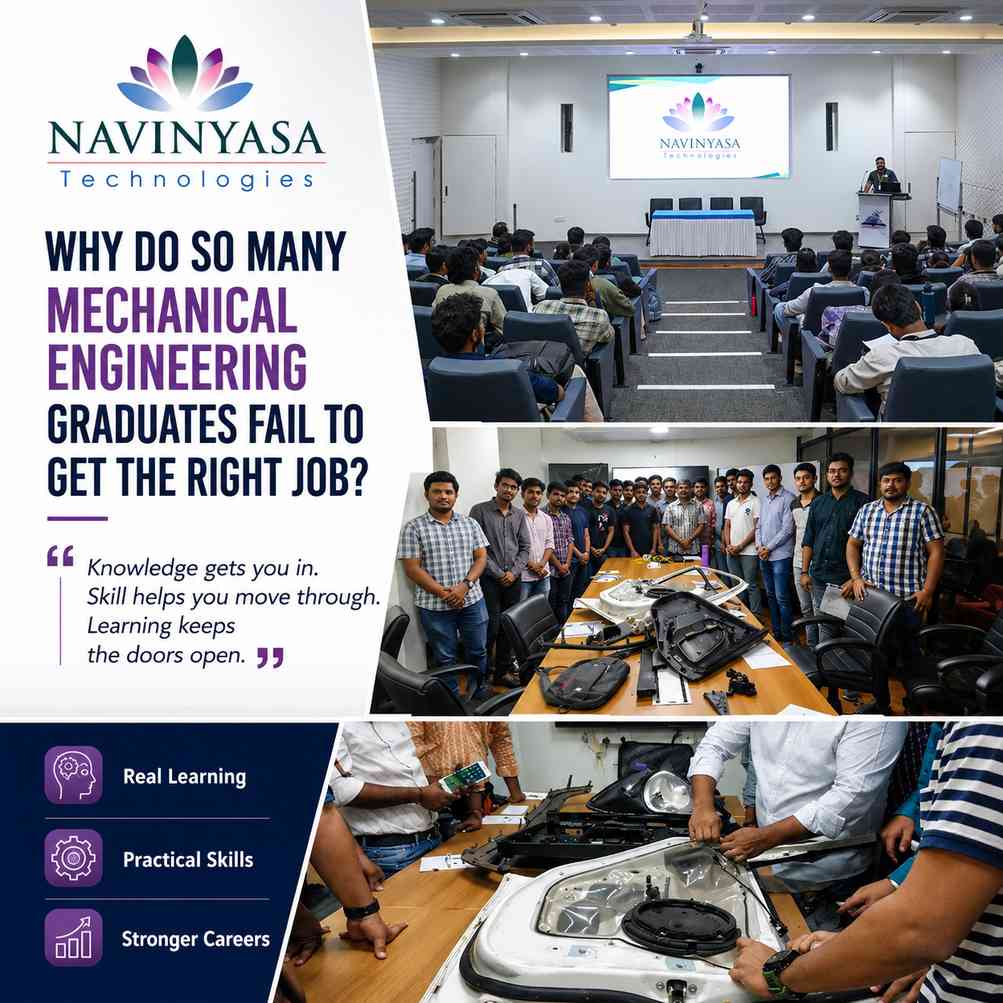
A few weeks ago, I was speaking with a group of final-year mechanical engineering students.
One student asked me a question that has stayed with me ever since:
“Sir, if companies say there are jobs, why are so many of us still struggling to get hired?”
The room fell silent.
Not because there was no answer, but because almost everyone in that room had the same question.
Every year, thousands of mechanical engineering graduates leave college with years of hard work behind them and a future full of expectations ahead of them.
They dream of designing automobiles, developing products that solve real problems, contributing to India’s manufacturing growth, or building a meaningful engineering career.
Yet, within a few months of graduation, many begin to doubt themselves.
“Was my degree enough?”
“Did I learn the right skills?”
“What exactly are companies looking for?”
After spending years working with students, engineering professionals, recruiters and manufacturing organisations, I have realised something important.
The problem is not that there are no opportunities.
The problem is that the definition of an industry-ready engineer has changed.
The Definition of an Industry-Ready Engineer Has Changed
Modern manufacturing does not operate the way it did a decade ago.
Automotive companies are designing for electric mobility.
Factories are becoming more intelligent through Industry 4.0.
Simulation is reducing dependence on physical prototyping.
Artificial Intelligence is assisting engineers in design validation.
Products are becoming smarter, lighter, faster and more sustainable.
Naturally, companies have changed the way they evaluate engineering talent.
Today, recruiters are not impressed simply because someone has completed a mechanical engineering degree.
They want evidence that a candidate can contribute from Day One.
What Recruiters Are Really Looking For
Instead of asking only:
“What was your percentage?”
Recruiters increasingly ask questions such as:
- Tell me about a project where you solved an engineering problem.
- Which CAD, CAM or CAE tools are you comfortable using?
- Have you worked on a manufacturable design?
- Can you explain your design decisions?
- Have you collaborated with a production or quality team?
- Do you understand how the component you designed will actually be manufactured?
These questions reveal something that marksheets cannot:
Capability.
The Biggest Misconception
Many graduates believe that earning a degree automatically makes them employable.
The industry does not see it that way.
A degree proves that you have studied engineering.
Practical exposure proves that you can apply engineering.
That is where many careers either begin—or stall.
Software knowledge is useful, but knowing how to operate a CAD tool is not the same as understanding product design.
A strong engineer must understand:
- Why a particular material is selected
- How a part will be manufactured
- What design constraints must be considered
- How quality will be validated
- How the design affects tooling, cost and assembly
- How engineering decisions influence the complete product lifecycle
What Makes an Engineer Valuable?
In my experience, companies rarely hire the person who knows the most theory.
They hire the person who can:
- Think critically
- Solve practical problems
- Adapt quickly
- Learn continuously
- Work collaboratively
- Understand manufacturing realities
- Explain engineering decisions clearly
- Take responsibility for outcomes
Software can automate processes.
Artificial Intelligence can accelerate design.
But neither can replace engineering judgement.
That ability is built through practical exposure, repeated problem-solving, project experience and continuous learning.
The Engineers Who Will Lead Tomorrow
The future belongs to engineers who never stop learning.
Not those who simply collect certificates.
Not those who move from one software course to another without understanding how the tools are applied.
The engineers who will lead tomorrow are those who understand why they are using a particular tool or process.
They ask better questions.
They remain curious.
They are willing to solve problems instead of waiting for instructions.
They connect design decisions with manufacturing realities.
That mindset creates long-term engineering careers.
Ask Yourself One Question
Instead of asking:
“Are there enough jobs for mechanical engineers?”
Ask yourself:
“Am I becoming the kind of engineer that industries genuinely want to hire?”
That single question can completely change the direction of your career.
It shifts the focus from waiting for opportunities to actively building the skills, judgement and confidence required to earn them.
How Navinyasa Helps Build Industry-Ready Engineers
At Navinyasa Technologies, this belief has shaped everything we do.
We do not see engineering education as something that ends with a classroom or examination.
We believe engineering comes alive when students:
- Work on real projects
- Understand manufacturing processes
- Learn from experienced industry practitioners
- Study practical design constraints
- Build confidence in solving engineering problems
- Understand the relationship between design, tooling, manufacturing and quality
Our Mechanical Domain Training programs focus on practical knowledge in:
- Plastic component design
- Casting component design
- Sheet metal and BIW design
- Manufacturing processes
- Automotive product development
- Industry-oriented design practices
The objective is not merely to teach software.
The objective is to help engineers understand how products are designed, developed and manufactured in the real world.
Build Skills That Create Long-Term Opportunities
Whether you are preparing for your first interview or looking to take the next step in your engineering career, never stop investing in your skills.
A degree opens the first door.
Skills create opportunities.
Practical experience builds confidence.
Continuous learning creates a career that lasts.
Explore Navinyasa’s industry-focused Mechanical Domain Training programs and understand how practical manufacturing knowledge can strengthen your engineering career.