Draft Angle in Casting: How Much Draft Do Sand, Die and Investment Castings Need?
13 Oct 2026
navinyasanew
10 min read
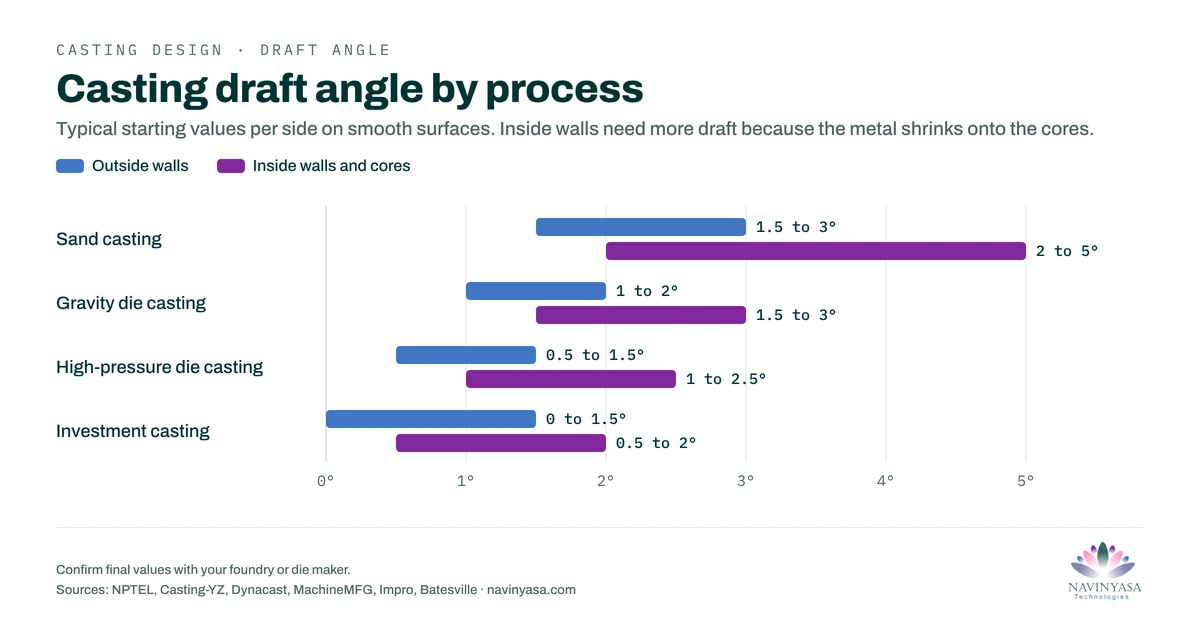
Short answer: most sand castings need 1.5 to 3 degrees of draft on outside walls, gravity die castings need 1 to 2 degrees, high-pressure die castings get by with 0.5 to 1.5 degrees, and investment castings often need little or none. Inside walls need more draft than outside walls in every one of these processes.
That’s the number. The rest of this guide is about why, because the why is what a toolmaker will ask you about.
If you’ve looked at a few casting drawings, you’ve probably seen a note like “All undimensioned drafts 2 degrees” tucked into the corner. It’s easy to treat as boilerplate. In reality, that small taper decides whether the pattern lifts out of the sand cleanly, whether a die casting pops off its cores without scoring, and whether your model comes back from the foundry with a list of changes.
Draft is a slight taper on any face that runs in the direction the pattern, core or die moves as it separates from the part. Without that taper, the two surfaces rub against each other on the way out, and something gets damaged.
What gets damaged depends on the process:
Sand casting: the pattern is pulled out of packed sand. A straight vertical wall drags sand with it and breaks the mould cavity, and the casting copies that broken shape.
Die casting and gravity die casting: the metal shrinks onto the steel as it cools. With no draft, the ejector pins have to force the part off. You get drag marks, bent thin walls and a die that wears out faster.
Investment casting: the wax pattern is pulled from its own die, but the ceramic shell around the metal is broken off, not opened. So draft mostly matters at the wax stage, and the process needs very little of it.
How is casting draft different from plastic draft?
The principle is the same. What changes is how much draft you need and who usually adds it.
You usually need more. Sand is weak and metal grips steel hard as it shrinks, so typical values run higher than on a polished plastic mould.
The pattern maker often adds it. In sand casting, draft is one of the standard pattern allowances, alongside shrinkage and machining allowance. Many drawings cover it with a general note instead of modelling it on every face.
Machined faces need a second look. If a drafted face gets machined flat later, the machining allowance has to cover the thick end of the taper, not just the nominal size.
Casting draft angle by process
These are typical starting values per side, on smooth surfaces. Use them as the first number you put in your model, then check with the foundry or die maker before you release the drawing. Their pattern material, alloy and surface finish will set the final figure.
Process
Outside walls
Inside walls and cores
Why it lands here
Sand casting
1.5 to 3 degrees
2 to 5 degrees
The pattern comes out of loose, fragile sand, so it needs the most taper
Gravity die / permanent mould
1 to 2 degrees
1.5 to 3 degrees
The mould is reusable steel or cast iron, but the metal still shrinks onto the cores
High-pressure die casting
0.5 to 1.5 degrees
1 to 2.5 degrees
Polished dies and ejector pins allow less draft outside, while cores grip hard
Investment casting
0 to 1.5 degrees
0.5 to 2 degrees
The shell is broken away, so draft mostly helps the wax pattern leave its die
Sand casting is forgiving about part size and unforgiving about draft. About 1.5 degrees is a common default on outside walls, and pattern makers often go higher on short features.
Here’s the part that catches most students out: taller walls can actually use a smaller angle. This table from the NPTEL metal casting course shows typical draft allowances for a wooden pattern.
Height of surface
Outside surface (degrees)
Inside surface (degrees)
Up to 1 inch
3.00
3.00
1 to 2 inches
1.50
2.50
2 to 4 inches
1.00
1.50
4 to 8 inches
0.75
1.00
8 to 32 inches
0.50
1.00
It makes more sense in millimetres than in degrees. On a tall wall, even half a degree adds up to a lot of taper by the time you reach the bottom. On a short boss, you need a bigger angle just to get any real clearance. Metal patterns can run a little less than wood, because they’re smoother and hold their shape better.
Gravity die and permanent mould casting
Here the mould is steel or cast iron and gets reused thousands of times, so draft protects the mould as much as the part. Some permanent mould foundries ask for around 3 degrees as a general value. That’s higher than most textbook ranges, which is a good reason to ask your foundry before you assume the low end will do.
Die casting draft angle
High-pressure die casting lets you use the least draft on outside walls, often 0.5 to 1 degree, because the die is polished and ejector pins push the part out. Inside surfaces are a different story. As the casting cools, it shrinks tightly onto the cores, so those walls need a lot more. Dynacast recommends roughly twice as much draft on inside walls as on outside ones.
Investment casting draft angle
This is the process where draft gets closest to zero. The wax pattern shrinks away from its die as it cools, and the ceramic shell is broken off rather than opened. Plenty of investment castings need little or no draft at all. When they do need some, it’s usually for the wax die, on deep pockets or around ceramic cores.
Why do inside walls need more draft?
Metal shrinks toward its own centre as it cools. Outside walls shrink away from the mould, which helps them release. Inside walls, like the bore of a housing or a pocket between ribs, do the opposite. They shrink onto the core that formed them and hold on tight.
That’s why every process in the table asks for more draft inside, and why die casters often want double. If your part has a deep pocket or a cored hole, give it the bigger value from the start. It’s a lot easier than redoing it after the die maker flags it.
How to convert draft angle to millimetres
CAD asks you for degrees, but the shop floor thinks in millimetres. To see how far one side of a wall moves over its height, use:
\text{taper per side} = h \times \tan(\theta)
Here h is the wall height in the direction of draw, and the angle is your draft.
Wall height
At 1 degree
At 3 degrees
20 mm
0.35 mm
1.05 mm
100 mm
1.75 mm
5.24 mm
Two things jump out from those numbers:
Draft changes tall walls a lot. At 3 degrees, a 100 mm wall ends up more than 5 mm narrower at one end. If that face mates with another part or gets machined later, you need to plan for the extra metal.
A small angle barely helps a short feature. That’s why short bosses and shallow pockets often get a bigger angle than tall walls.
Where the parting line goes decides how draft runs
Draft always runs away from the parting line, in the direction each half of the mould or die moves. So settle where the part splits before you add a single degree of draft.
Each half drafts away from the split. Faces in the top half taper one way, and faces in the bottom half taper the other.
A parting line in the middle of a tall wall halves the taper on each side. Split a 100 mm wall at 50 mm and each half only tapers over 50 mm, so the part stays closer to its nominal size.
Cores have their own direction of draw. A side core pulls out sideways, so the holes and pockets it forms need draft along that axis, not along the main parting direction.
Picture the pattern coming out. In sand casting, imagine lifting the pattern straight up out of the sand. Any face that would rub or catch on the way out needs draft or a core.
Plenty of castings get machined on their mounting faces, bores and sealing surfaces. If a drafted face is going to be machined flat or square:
Add the machining allowance on top of the thick end of the taper, not the nominal size.
Mark it clearly on the drawing as a machined face, so nobody trims its draft to save metal.
Keep the draft on neighbouring faces that stay as-cast.
Common draft mistakes in student casting models
When we review casting work in our training sessions, the same few problems show up again and again:
Modelling it like a machined part. Every wall dead vertical, no draft, sharp corners everywhere. It looks tidy on screen, but no foundry can cast it as drawn.
One draft value for everything. Inside pockets, outside walls and tiny bosses all get the same 1 degree. The cores grip, and the bosses get almost no clearance.
Adding draft before picking the parting line. Half the faces end up drafted the wrong way, and the model has to be redone.
Drafting only one side of a wall. The wall gets thicker toward one end, which changes how it cools and invites shrinkage defects.
Forgetting about machined faces. The machining allowance gets added to the nominal size, and the thin end of the taper doesn’t have enough stock to clean up.
Borrowing plastic values. Half a degree might be fine on a polished plastic mould. On a sand casting, it’s nowhere near enough.
Casting draft checklist
Go through this before you send a casting model for review:
Casting process confirmed: sand, gravity die, high-pressure die or investment
Parting line and main direction of draw fixed
Direction of draw set for every core and side core
Draft on every face that runs parallel to a direction of draw
More draft on inside walls and cores than on outside walls
Short features given enough angle to clear, and tall walls checked in millimetres
Both sides of each wall drafted, so the thickness stays even
Machined faces marked, with machining allowance added at the thick end
A general draft note on the drawing, for example “All undimensioned drafts 2 degrees”
Final values confirmed with the foundry or die maker
Frequently asked questions
What is the standard draft angle for casting?
There isn’t one standard figure. A sensible starting point is 1.5 to 3 degrees for sand casting, 1 to 2 degrees for gravity die casting, 0.5 to 1.5 degrees on outside walls for high-pressure die casting, and little or none for investment casting. Inside walls need more in all of them.
Why do inside surfaces need more draft than outside surfaces?
Because metal shrinks as it cools. Outside walls pull away from the mould, but inside walls shrink onto the core that formed them and grip it. The extra draft lets the core come out without damaging the part.
Does draft depend on how tall the wall is?
Yes. Draft tables give smaller angles for taller walls, since even a small angle builds up a big taper over a long height. Short features need a larger angle to clear at all.
Can a casting have zero draft?
Investment castings often can, because the ceramic shell is broken away rather than opened. Sand and die castings nearly always need some. Asking for zero draft on those usually means a costlier tool, a side core or an extra machining step.
Is casting draft the same as plastic draft?
Same idea, different numbers. Castings, sand castings especially, usually need more draft than a polished plastic mould. Our plastic draft angle guide covers the moulding side if you want to compare.
Who decides the final draft angle?
You put a sensible value in the model and on the drawing. The foundry or die maker then confirms it based on their pattern material, alloy, finish and equipment. Always check with them before you release the design.
Learn casting design the way the shop floor sees it
Draft is one of those small details that separates a CAD model from a part a foundry can actually make. Parting lines, cores, wall thickness, fillets and machining allowance all work the same way.
Navinyasa’s Casting Component Design Training in Bengaluru covers casting materials, sand, die, gravity and investment casting, tool direction, parting lines and design guidelines. You work on live projects with mentors who design these parts for industry.
Book a free demo, or WhatsApp us on +91 990 113 6476 to see how the program works.
Book a Free Demo. See What Design-Ready Training Looks Like.
Build practical mechanical design skills through domain-focused training in Plastic, Casting and Sheet Metal/BIW with live project exposure, manufacturing knowledge and mentor guidance.
Upcoming batches have limited seats. Book a free demo to understand the program structure, domain options and learning approach.
See How Domain Training Can Strengthen Your Design Career.
CAD software knowledge is only the starting point. Explore how practical training in Plastic, Casting and Sheet Metal/BIW, manufacturing processes and live projects can help you move toward design-ready skills.
Upcoming batch • Limited training seats. Book a free demo to understand the training approach before you decide.