Plastic Product Designer: What the Job Involves, the Skills Companies Ask For, and How to Become One
17 Nov 2026
navinyasanew
6 min read
Look around the room you’re sitting in. The switch on the wall, the phone case, the chair’s armrest, the TV remote. Every one of them started on a plastic product designer’s screen. In a car, it’s the bumper, the dashboard, the door trims and hundreds of clips you’ll never see.
Plastic design roles show up regularly in job listings around Bengaluru, Pune and Chennai, where automotive and consumer product companies keep design teams. It’s also a role that’s often misunderstood. Many freshers think it means “good at CAD”. Hiring managers think it means something else.
This guide explains what the job really involves, the skills that show up again and again in real job descriptions, and a practical path to get there.
What does a plastic product designer actually do?
A plastic product designer turns an idea, a styling surface or a broken old part into a plastic part that can be moulded, assembled and used for years. The CAD model is only the visible part of the work.
Take a simple example: a plastic cover that clips onto a car’s door panel. The designer has to:
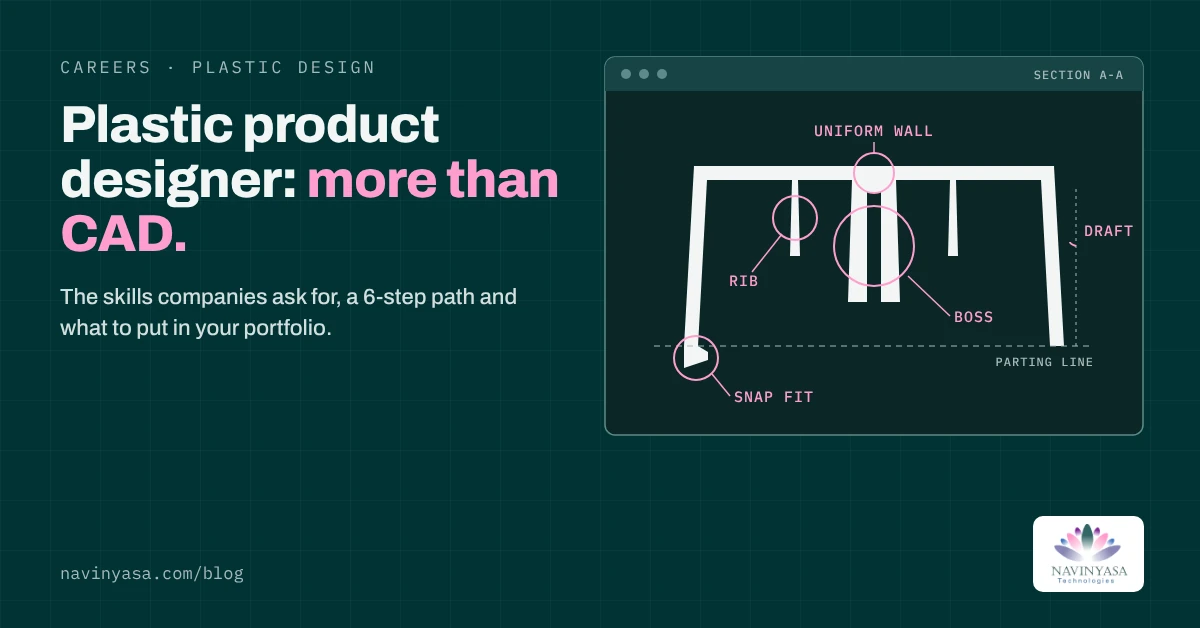
Shape it in CAD from the styling surface, keeping the walls even so it doesn’t warp.
Add draft so it comes out of the mould, and check where the parting line falls.
Design the clips, often snap fits, so they hold firmly but don’t crack during assembly.
Add ribs and bosses for stiffness and screws, without causing sink marks on the visible face.
Choose the material (PP, ABS, PC/ABS, PA) for strength, heat, cost and finish.
Make the 2D drawing with GD&T, so the supplier knows exactly what to check.
Work with the toolmaker, then check the first samples and fix what’s wrong.
In short: the job is designing parts that the tool can make, the assembly line can fit, and the customer won’t break.
Where plastic product designers work in India
Automotive OEMs and Tier 1 suppliers: interior and exterior trims, bumpers, lamps, consoles, instrument panels.
Engineering design service companies: design work for global OEMs, often in Bengaluru, Pune and Chennai.
Consumer products and appliances: kitchen appliances, electrical fittings, personal care devices, toys.
Electronics and medical devices: housings, enclosures and precision moulded parts.
Mould makers and moulders: design for manufacturing support and tool design.
The skills companies actually ask for
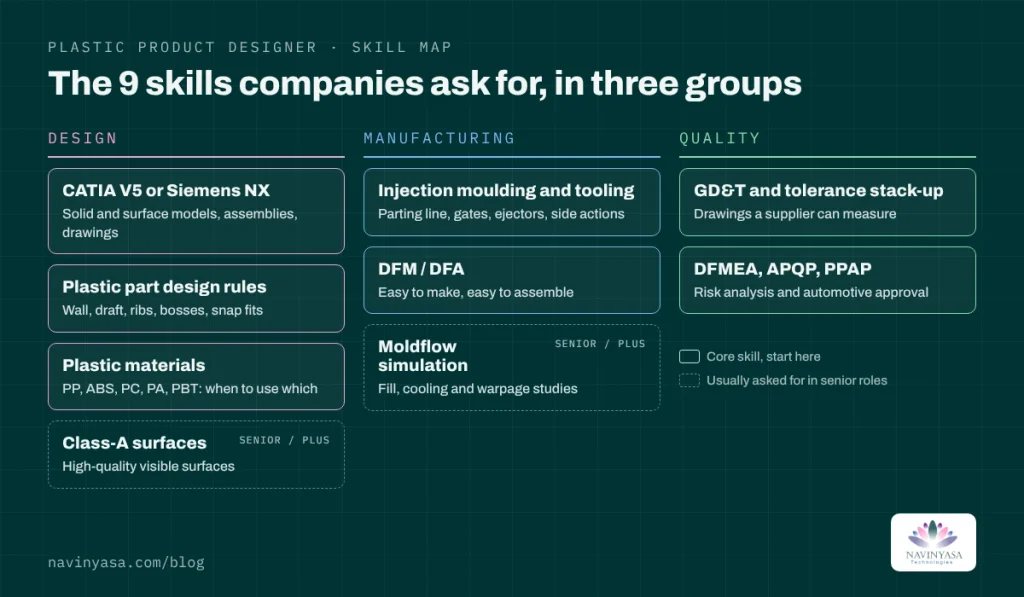
We looked at recent job descriptions for plastic design roles in India and abroad, from Bengaluru and Pune design teams to Tier 1 suppliers. The same skills come up again and again:
Skill
What it means in practice
In the listings we reviewed
CATIA V5 or Siemens NX
3D solid and surface modelling, assemblies, 2D drawings. SolidWorks and Creo show up more in consumer products.
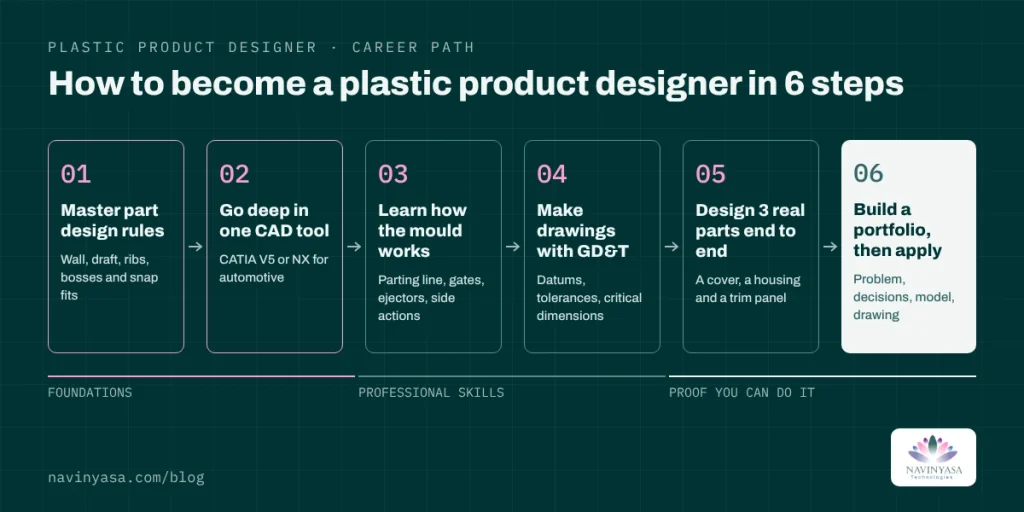
Pick one CAD tool and go deep. For automotive, CATIA V5 or NX. For consumer products, SolidWorks or Creo is also common. Depth in one tool beats a little of four.
Learn how the mould works. You don’t need to design tools, but you need to know how the mould opens, where the parting line goes, and why a side action costs money. Visit a moulding shop if you can.
Learn to make a proper drawing. Datums, GD&T, critical dimensions and notes. Read our post on the 3-2-1 principle of location to see why datums matter.
Design 3 real parts end to end. A clip-on cover with snap fits, a housing with screw bosses, and a trim panel with ribs. Take each from concept to model, drawing and a DFM checklist.
Build a portfolio and apply. Show each project as: the problem, your design decisions, the CAD model, the drawing, and what you’d change next time.
What to put in your portfolio
Some job descriptions ask candidates to show 3 to 5 plastic component projects with 3D models and GD&T drawings. Make each one easy to judge in two minutes:
One image of the finished part and one of the assembly it fits into
A section view showing wall thickness, ribs and draft
The 2D drawing with datums and key tolerances
Three design decisions you made and why
One problem you found and fixed (a sink mark, an undercut, a snap fit that would crack)
That last point does more for you than any certificate. It shows you think like a designer.
Common mistakes freshers make
Treating plastic like steel. Thick walls “for strength” cause sink marks and warpage. Ribs add stiffness; thick walls add problems.
Forgetting draft. A part with vertical walls looks clean in CAD and won’t come out of the mould.
Only learning software. Knowing every CATIA command won’t help if you can’t explain where the parting line goes.
No drawings in the portfolio. Hiring managers check drawings first, because that’s where design understanding shows.
Applying everywhere with one resume. An automotive trims role and an appliance role want different examples. Tailor them.
What does a plastic product designer earn?
Pay varies widely by city, company type and experience, so treat any single number with care. As one example, a Pune listing for an automotive plastics design engineer in August 2026 offered INR 4 to 6 lakh a year. Check AmbitionBox or Glassdoor for current ranges in your city and target company.
Frequently asked questions
Can a mechanical engineer become a plastic product designer?
Yes. Most plastic product designers in India are mechanical engineers. What they add on top of the degree is plastic part design rules, one CAD tool in depth, and a basic understanding of moulding and tooling.
Which software is best for plastic product design?
For automotive, CATIA V5 and Siemens NX appear in most job descriptions. SolidWorks and Creo are common in consumer products. Learn one well before adding another.
Do I need to know mould design?
Not to design moulds yourself, but you need to understand how they work: parting lines, draft, gates, ejectors and side actions. Designers who understand the tool make parts that cost less and fail less.
How long does it take to become job-ready?
It depends on your starting point and how much you practise. What matters most is having designed a few real parts end to end, with drawings, before you apply.
What’s the difference between a plastic product designer and a CAD engineer?
A CAD engineer models what they’re given. A plastic product designer decides what the part should look like and why, so it can be moulded, assembled and used. Read more in our post on CAD engineer vs design engineer.
Learn plastic product design on real parts
Navinyasa’s mechanical design training in Bengaluru teaches Plastic, Casting and Sheet Metal design the way design teams work: real automotive parts, real drawings, and design reviews by working engineers. Ask us how the projects can become part of your portfolio.
Talk to our training team: call +91 99011 36476 or WhatsApp us. Or book a free demo session.
Book a Free Demo. See What Design-Ready Training Looks Like.
Build practical mechanical design skills through domain-focused training in Plastic, Casting and Sheet Metal/BIW with live project exposure, manufacturing knowledge and mentor guidance.
Upcoming batches have limited seats. Book a free demo to understand the program structure, domain options and learning approach.
See How Domain Training Can Strengthen Your Design Career.
CAD software knowledge is only the starting point. Explore how practical training in Plastic, Casting and Sheet Metal/BIW, manufacturing processes and live projects can help you move toward design-ready skills.
Upcoming batch • Limited training seats. Book a free demo to understand the training approach before you decide.