Automotive Component Design: How BIW, Sheet Metal, Plastics and Casting Come Together in One Car
10 Nov 2026
navinyasanew
10 min read
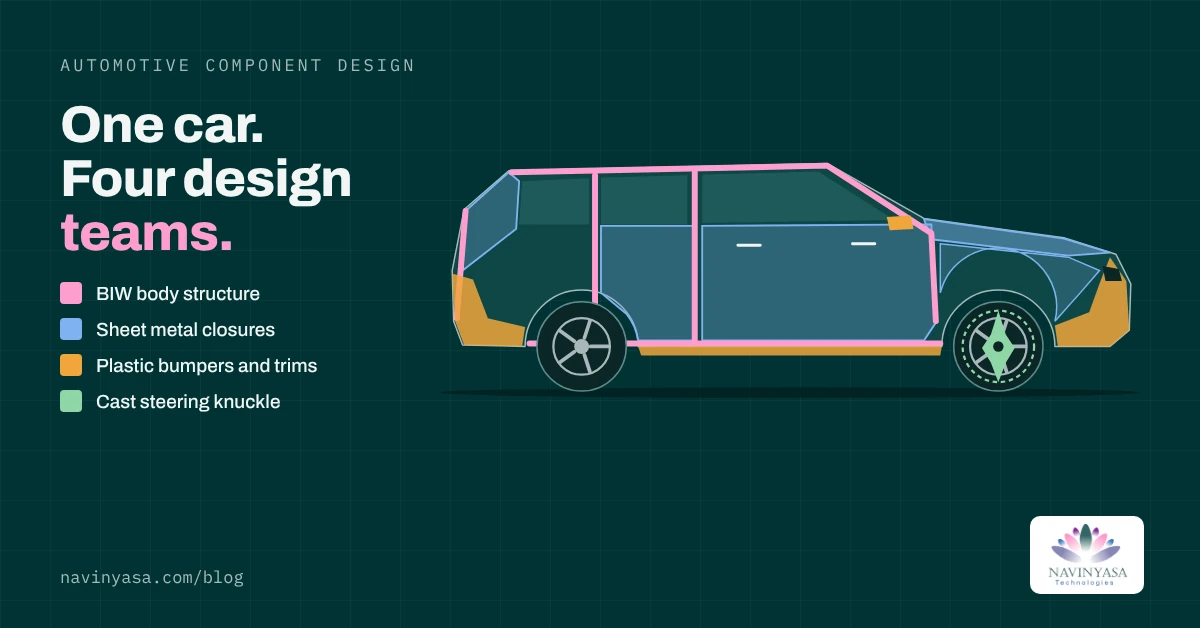
Walk up to any compact SUV in a Bengaluru parking lot and you’re looking at the work of four different design teams. The bumper you could dent with your knee was designed by plastics engineers. The hood was designed by a sheet metal team. The steel cage you can’t see, the one that keeps you alive in a crash, is the Body in White (BIW). And the steering knuckle behind the wheel, holding everything together at 100 km/h, is a casting.
Each of these teams works with different materials, different tools and different rules. Yet they all design into the same tight space, to the same deadline, and their parts have to fit together to within a millimetre.
In this guide we’ll take one car apart, domain by domain. You’ll see what each team designs, how the part is made, the design rules that matter most, and where the domains meet. If you’re an engineer choosing a specialisation, or a company looking for design support, this is the map.
One car, four design domains
Domain
Typical parts
How they’re made
Main material
What the designer worries about most
BIW
Floor, pillars, roof rails, side frames, cross members
Stamped panels joined by spot welds, adhesives and rivets
Mild steel, high-strength steel, press-hardened steel, some aluminium
Crash load paths, stiffness, weld access, weight
Sheet metal (closures and brackets)
Hood, doors, tailgate, fenders, mounting brackets
Stamping, hemming, bending
Steel and aluminium sheet
Dent resistance, hemming, gaps and flush, bend rules
Plastics
Bumpers, dashboard, door trims, grilles, clips
Injection moulding
PP, ABS, PC/ABS, PA
Wall thickness, draft, ribs, snap fits, sink marks
Casting
Steering knuckles, engine blocks, motor housings, brackets, large underbody castings
Body in White is the car’s welded body structure before paint, doors, trims or the powertrain go on. It’s called “white” because, at this stage, it’s bare metal waiting for the paint shop.
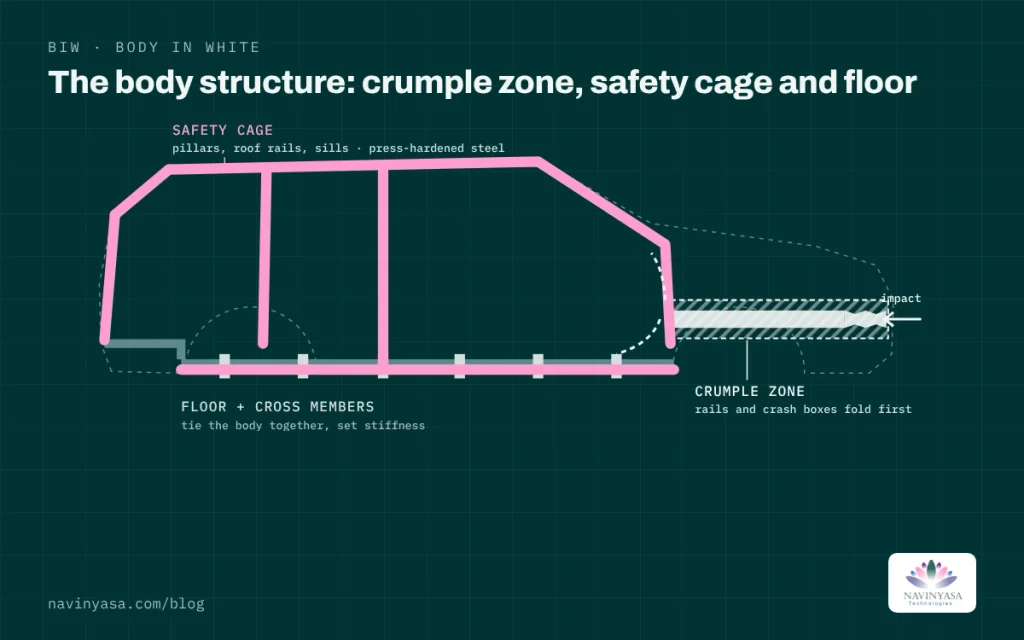
BIW is where safety lives. In a frontal or side crash, the BIW has to carry the impact energy around the passenger cabin rather than through it. That’s why different zones use very different steels:
Crumple zones (front rails, crash boxes) use steels that fold and absorb energy.
The safety cage (A-pillars, B-pillars, roof rails, sills) uses the strongest steels, often press-hardened steel. These are heated to about 900°C, formed while hot and quenched in the die, reaching 1,500 MPa and more in tensile strength.
The floor and cross members tie everything together and set the body’s stiffness, which affects handling and noise.
A BIW is built from hundreds of stamped panels joined mostly by resistance spot welds, plus structural adhesive and rivets. The numbers add up fast: the MINI plant in Oxford, for example, makes about 6,000 spot welds on every car.
What a BIW designer actually does:
Designs panels in CATIA or NX that can be stamped without splitting or wrinkling.
Plans flanges, typically wide enough for a spot weld gun to reach and clamp.
Checks weld access for robots and fixtures. A weld the robot can’t reach doesn’t exist.
Works with CAE engineers on crash and stiffness results and changes thickness or steel grade where needed.
Defines locating holes and datums so the body sits the same way in every welding fixture. This is the 3-2-1 principle of location at work on a much larger scale.
Common beginner mistake: designing a beautiful panel in CAD with no thought for how two panels will be welded together. In BIW, the joint is the design.
2. Sheet metal: closures and brackets
BIW engineers design the body. Sheet metal engineers design the parts that open and close on it, called closures (hood, doors, tailgate, fenders), plus hundreds of small brackets that hold everything from wiring to the battery.
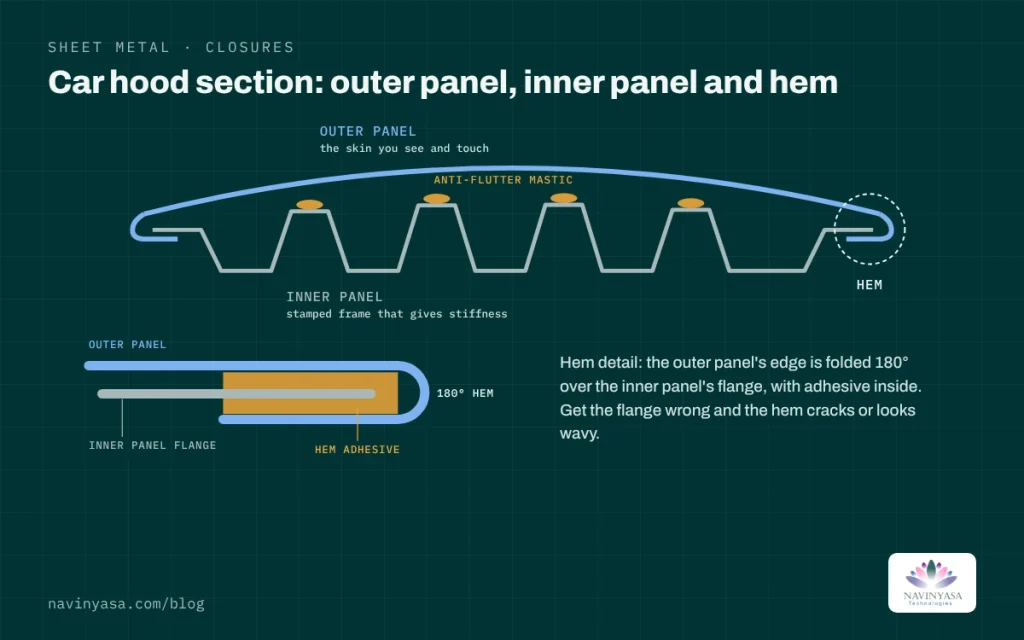
Take the hood. It’s two panels, not one:
The outer panel is what customers see and touch. It has to resist dents from a palm pressing on it and stay perfectly smooth after painting.
The inner panel is a stamped frame that gives the hood its stiffness, with holes cut out to save weight and space for the latch and hinges.
They’re joined by hemming: the edge of the outer panel is folded 180° over the inner, usually with adhesive inside. Design the flange wrong and the hem cracks or looks wavy.
Closer to the ground, a simple steel bracket that holds a radiator or a wiring harness follows a different set of rules: bend radius, bend allowance, hole distance from the bend, and grain direction. Get the bend allowance wrong and the flat blank comes out the wrong size, so the holes won’t line up on the car.
What a sheet metal designer actually does:
Designs closures to meet gap and flush targets, the even gaps you see around a door.
Plans hinge and latch reinforcements so the door doesn’t sag after years of slamming.
Develops flat patterns and checks formability for brackets.
Keeps holes and cut-outs a safe distance from bends so they don’t distort.
Common beginner mistake: putting a hole right next to a bend. It stretches into an oval when the part is bent.
3. Plastics: bumpers, dashboards and trims
Look inside the same SUV and almost everything you touch is plastic: the dashboard, the door trims, the console, the air vents, the clips you never see. Outside, it’s the bumpers, grille, wheel arch liners and mirror housings.
Plastics are a small share of a car’s weight but a huge share of its volume. According to the American Chemistry Council, the average light vehicle carries about 411 pounds (around 186 kg) of plastics, which is under 10% of its weight and roughly half of its volume.
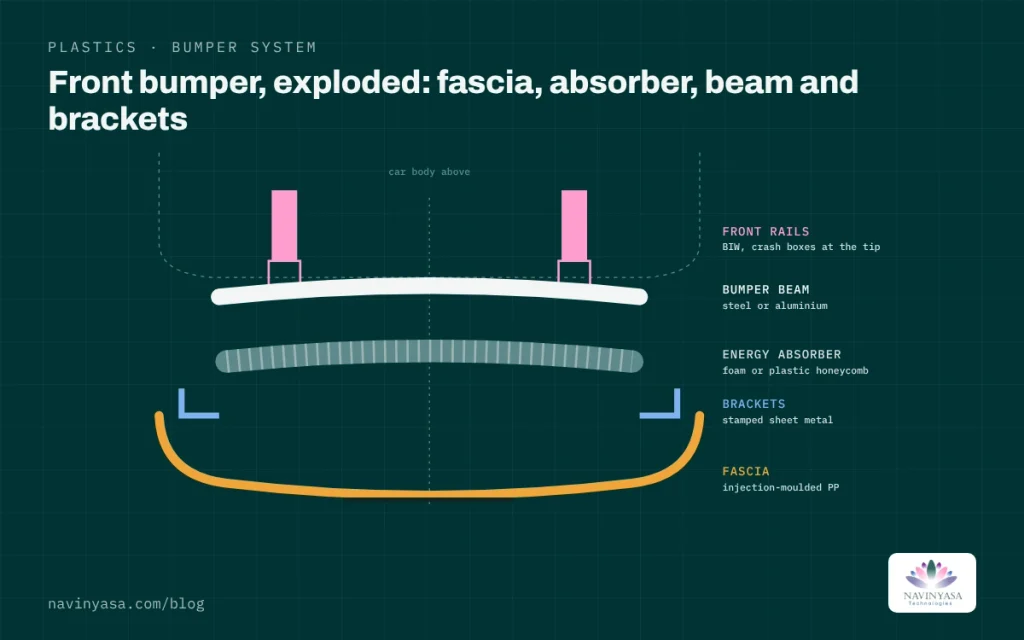
Take the front bumper. It’s not one part but a small system:
The bumper fascia is the painted outer skin, usually injection-moulded PP. It has to flex in a parking knock and spring back.
Behind it sits an energy absorber (often foam or a plastic honeycomb) and, behind that, a steel or aluminium bumper beam that’s part of the crash structure.
The fascia clips to the body with dozens of snap fits and screw bosses, and it has to line up with the headlamps and fenders with even gaps.
What a plastics designer actually does:
Keeps wall thickness as uniform as possible, so the part cools evenly and doesn’t warp.
Adds draft angles on every wall so the part comes out of the mould, with more draft on textured surfaces.
Designs ribs and bosses that add strength without sink marks on the visible side.
Designs snap fits that click in during assembly and survive removal at service.
Works with the toolmaker on parting lines, gates and ejector positions.
Common beginner mistake: making a wall thicker “to make it stronger”. In plastics, a thick wall causes sink and warpage. Ribs make parts stiff; thick walls make them ugly.
4. Casting: knuckles, housings and the big new castings
Castings go where a part needs a complex 3D shape, high strength and few joints. In our SUV, that means the steering knuckles, the engine block and cylinder head (or, in an EV, the motor and inverter housings), the gearbox case, suspension brackets and the brake calipers.
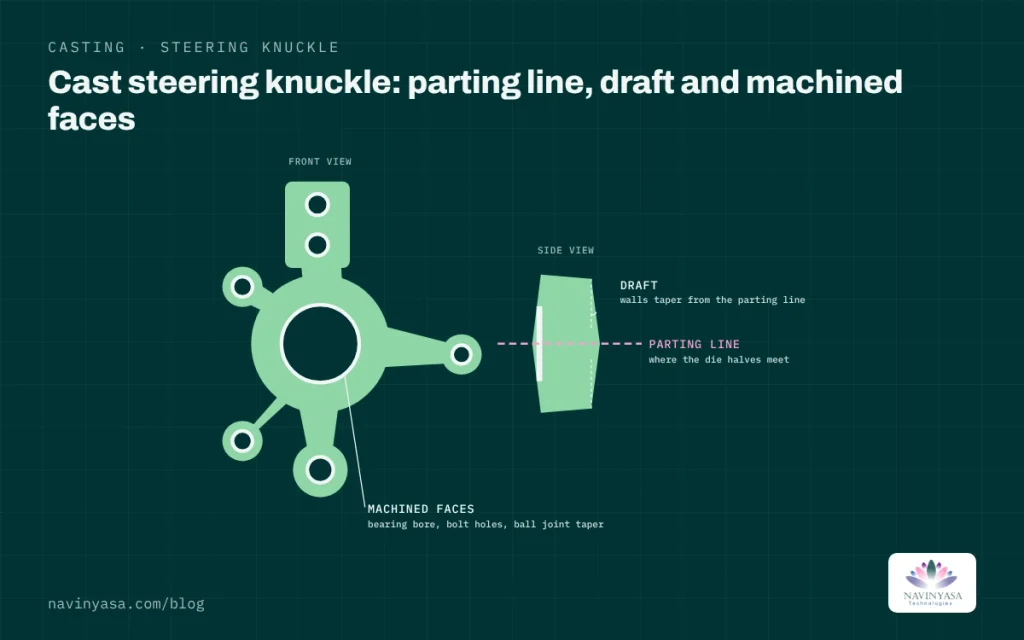
Take the steering knuckle. It connects the wheel hub, brake caliper, steering tie rod and suspension arms, all in one part. It carries braking, cornering and pothole loads. It’s often cast aluminium or iron, then machined at the bearing bore and mounting faces.
Casting is also changing how car bodies are built. Tesla replaced the Model Y’s rear underbody, which on the Model 3 used about 70 stamped and welded parts, with large aluminium castings, a move often called gigacasting. Other carmakers are now testing the same idea. For a designer, this blurs the line between BIW and casting: the body itself is starting to be cast.
What a casting designer actually does:
Places the parting line so the part can be removed from the die and critical dimensions stay in one half.
Adds draft to every wall that moves against the die.
Keeps sections even and avoids heavy blobs where porosity forms.
Leaves machining stock on faces that need tight tolerances, and defines datums for the machining fixture.
Works with simulation engineers on filling and solidification before the die is cut.
Common beginner mistake: designing a casting like a machined part, with sharp corners, uneven walls and no draft. The foundry will either refuse it or ship it full of defects.
Where the four domains meet
The hardest problems in automotive design aren’t inside one domain. They’re at the joints between them.
Bumper to body: the plastic fascia (plastics) clips onto brackets (sheet metal) mounted on the front rails (BIW), with the bumper beam behind it. If the BIW mounting points move by 2 mm, the fascia gap to the headlamp goes wrong.
Door trim to door: a plastic trim panel snaps onto a stamped door inner. The clip positions, hole sizes and tolerances have to agree between two teams.
Knuckle to suspension: a cast knuckle bolts to suspension arms that mount on a subframe, which mounts on the BIW. Every interface has its own tolerance, and they all stack up.
This is why companies value engineers who understand more than one domain. A plastics designer who knows how the BIW is welded asks better questions in design reviews, and makes fewer late changes.
Which domain suits you?
If you enjoy…
Look at…
Skills to build first
Structures, crash safety, big assemblies
BIW
Sheet metal design in CATIA or NX, joining methods, GD&T, datums and fixtures
Clean, visible surfaces and mechanisms
Closures and sheet metal
Bend rules, hemming, gap and flush, hinge and latch design
Whichever you choose, three skills carry across all four: reading and making drawings with GD&T, understanding how the part is manufactured, and checking tolerance stack-ups.
Want to work in automotive design? Our mechanical design training in Bengaluru covers Plastic, Casting and Sheet Metal design on real automotive parts, taught by working engineers. Call or WhatsApp us on +91 99011 36476 to talk to the training team, or book a free demo.
For automotive companies
Navinyasa’s engineering studio in Bengaluru supports OEMs and suppliers with automotive design services across BIW, plastics and CAE, plus reverse engineering and prototype support. If your team needs extra design capacity on a programme, send us an enquiry or call +91 99011 36476 or WhatsApp us
Frequently asked questions
What is BIW in automotive design?
BIW (Body in White) is the car’s welded steel or aluminium body structure before painting and before doors, trims and the powertrain are added. It carries crash loads and gives the body its stiffness.
What’s the difference between BIW and sheet metal design?
BIW design covers the welded body structure. Sheet metal design in automotive usually means the closures (hood, doors, tailgate, fenders) and the many brackets mounted on the body. Both use stamped sheet, but the design focus is different.
Which plastics are used in cars?
Polypropylene (PP) for bumpers and many trims, ABS and PC/ABS for interior parts and housings, and polyamide (PA, nylon) for under-hood parts and clips are among the most common.
Which car parts are cast?
Steering knuckles, engine blocks and cylinder heads, gearbox cases, EV motor housings, brake calipers and some brackets. Some carmakers now cast large sections of the underbody too.
Which domain is best for a career in automotive design?
There’s no single best one. Start with the domain that matches what you enjoy, then learn how it connects to the others. Engineers who understand two or more domains are more useful in design reviews and catch problems earlier.
Want to design parts like these?
Our Bengaluru training covers Plastic, Casting and Sheet Metal design on real automotive parts.
Book a Free Demo. See What Design-Ready Training Looks Like.
Build practical mechanical design skills through domain-focused training in Plastic, Casting and Sheet Metal/BIW with live project exposure, manufacturing knowledge and mentor guidance.
Upcoming batches have limited seats. Book a free demo to understand the program structure, domain options and learning approach.
See How Domain Training Can Strengthen Your Design Career.
CAD software knowledge is only the starting point. Explore how practical training in Plastic, Casting and Sheet Metal/BIW, manufacturing processes and live projects can help you move toward design-ready skills.
Upcoming batch • Limited training seats. Book a free demo to understand the training approach before you decide.